
Vima
Exploring interactions beyond screens to re-think the fitness experience.


BACKGROUND
Vima is my Personal Honours Project in my final year at the University of Dundee. As part of the Digital Interaction Design degree, every fourth-year student spends two semesters working independently on a project of their choice.
During this time, I had the opportunity to craft my own brief, research the people, issues, and opportunities for design within a subject of my choice, prototype and test ideas, and develop concepts that were both effective and meaningful. I was responsible for managing the project from start to finish, giving me the freedom to explore my own interests while further developing my skills as a designer.
EXPLORING ALTERNATIVE INTERACTIONS
My research began in the summer of 2016, when I read Golden Krishna’s book The Best Interface Is No Interface, which challenged my assumptions about what a good user experience should look like.
Krishna argues that while mobile apps were innovative a decade ago, now they are very much the result of thinking inside the box. He advocates the future of creating great user experiences is rooted in understanding what is already happening in the environment of users and leveraging technology to embrace their natural behaviours and processes. Not the other way around.
Good experience design isn’t about screens.
It's about good experiences.
Golden Krishna
A SEED WAS PLANTED, AND A SUBJECT EMERGED
This perspective gave me the direction I needed to begin my Honours Project. Rather than starting with a technology and looking for a problem to solve, I began by asking how technology could support an existing human activity without getting in its way.
Guided by Krishna's principles, I started working on the research phase of my project. I chose the subject of health & fitness as my topic of exploration, and in combination with my interest in physical-digital making, I set out to create a tool for the activity of High-Intensity Interval Training (HIIT) that most of all, would be mindful to the human experience.
THE PROBLEM
The distracting nature of our smart devices is having a significant impact on how we experience our day-to-day lives, with consequences for both productivity and mental wellbeing. Losing focus and getting distracted from the task at hand is something we have all experienced.
This realisation led me to investigate what designers can do to think beyond screens and create products that encourage positive user-habits and behaviours, rather than products that compete for our attention.
COLECTING INSIGHTS
I began the first part of my research by interviewing a number of professionals in the fitness industry to uncover as much as I could about HIIT, the secret for effective workouts and their observations regarding common mistakes people make when working out alone. Meanwhile, I launched a Google form survey to gather qualitative and quantitative data directly from people who frequent the gym.


RAPID PROTOTYPING FOR USER TESTING
Following the first round of interviews, I had gathered a lot of insights about the difficulties that people face at the gym, their habits when working out alone, and the limitations of certain exercises and gym equipment. I began to formulate a concept for a product that would aim to make both lower and upper body workouts a more enjoyable exercise experience for people of all training levels while helping to promote the benefits of HIIT. This idea mainly revolved around developing an interactive exercise mat that would benefit from a range of sensors, to help guide the user through their workout.
There were three main questions to be answered:
-
How would the user know to perform specific exercises?
-
How would they regulate the pace of the workout according to their fitness needs/levels?
-
How do I ensure this tool is inclusive to people of all fitness levels?


My approach utilised a range of prototyping techniques and involved users early on in the process to further understand the problem and define the main features of the product. By creating a series of low-fidelity, rapid prototypes to test different concepts with users, I uncovered the following insights:
-
Having a mat on the floor worked really well for the range of upper body exercises that I had discussed with the personal trainers at the beginning of my research
-
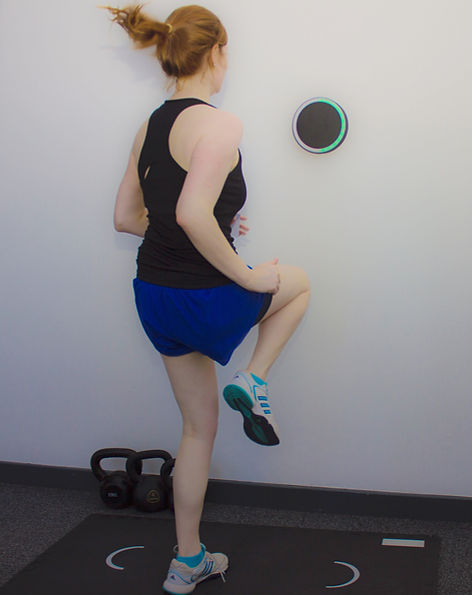
Placing a second mat in the user’s line of vision i.e. the wall, worked great for lower body exercises as it allowed them to perform the exercise without sacrificing good posture
-
Participants said they didn’t know when to start, when to rest and when to hydrate
-
Participants loved that they were able to customise their workout according to their needs
-
Most of the participants said they do not count reps when working out or if they do initially they lose track towards the end. The prototype helped them because it was counting down the reps for them leaving them to focus on the exercise at hand.
-
Since I had decided to construct this product for all fitness levels, it was important to give the user the ability to regulate the intensity level that the mat provides. In order to achieve this, I started designing an app that would connect wirelessly with the physical part of the product
If you’d like to read more about the user testing phase, then head to this blog post.
DESIGN AND TECHNOLOGY
The element of the project that was aimed towards lower body workouts, was perhaps the most challenging piece to design and build. By sketching out a few ideas on paper, I tried to plan the best solution to accommodate the electronics needed while maintaining an elegant and simple design, and ensuring consistency across the wall and floor elements of my project.
After a few iterations, I decided to create a wireless and portable disc where all the necessary electronics would be enclosed. VIMA required the use of two Genuinos, one for the wall element and one for the floor element that would communicate with each other via Bluetooth sensor, an RFID reader and rechargeable li-po batteries. This choice of design meant for fewer things to 3D print, less wiring to do and was by far the least expensive solution.

MAPPING OUT LIGHT BEHAVIOURS
The next challenge was finding a way to translate the user’s chosen exercises into light and motion. The lights needed to communicate the pace of the workout, count down repetitions, and signal when it was time to take a break.
While exploring possible solutions, I discovered a type of programmable LED called NeoPixels. What made them particularly interesting was the ability to control each pixel individually, allowing me to create complex patterns and behaviours using light.
I arranged the NeoPixels in a circle and began experimenting with different light behaviours to see how they could communicate the movements and requirements of different exercises, as illustrated in the adjacent diagram.
THE FINAL PROTOTYPE
Having learned a great deal from observing participants interact with my earlier prototypes, I used their feedback to refine the concept and move towards a high-fidelity prototype.
I used 3D modelling and 3D printing to develop the physical product, Arduino technology to program its behaviour, and Illustrator and Proto.io to prototype the accompanying app. Through continuous cycles of iteration, testing and refinement, I gradually brought the concept together into a fully functioning prototype.
The result is the final prototype shown here:


OUTCOMES
Besides the amazing learning experience that this project has been, some of the outcomes were receiving a First Class Honours degree and being offered an exciting UX/UI Design Internship within Prudential's Digital Proposition's Department.
🎓 Graduated with First Class Honours
🤝 Received an offer for a design internship at Prudential
SKILLS DEVELOPED
Product design
Interaction design
Research techniques
Conducting interviews
User testing
UI design
3D modelling and printing