
Salesforce voice copywriting assistant
Turning Salesforce’s writing guidelines into an on-demand writing assistant.


CONTEXT
In December of 2024, I earned a Certificate in Content Design with the end goal to create a set of guidelines that could bring greater consistency to UX writing across the Org62 platform - Salesforce’s internal org for go-to-market operations and my main focus during this period of time.
At this point our UX team didn't have a dedicated copywriter, which meant that UX copy was often hastily written by designers and product analysts as part of their day-to-day work. With multiple teams contributing to the org62 platform, there was a clear need for a shared set of principles that could help everyone approach UX writing more consistently and confidently.
Looking for existing resources, I discovered a PDF document outlining the Salesforce Voice, Tone and Style. This set of guidelines was a good starting point, with well defined rules and plenty of examples on how to write for Saleforce. To nobody’s surprise however, no one was referencing the document or was even aware of its existence.
What I realised pretty quickly was that we had an awareness and application problem.
THE PROBLEM
Applying the rules
There’s a large number of people who contribute copy to Org62. It’s a platform with many moving parts and multiple teams working on it. The issue was that the many designers and product analysts that work on it are not aware of the content design guidelines and how to apply them effectively to their UX writing.
OBJECTIVES
I didn't want to build yet another documentation repository as we have enough of those already. I wanted to build something that could apply the documentation and act as a thoughtful content design partner, providing feedback rooted in the Voice, Tone and Style guidelines, and offer suggestions to make the copy more aligned with the Saleforce brand.
THE SOLUTION
In May of 2026, Slack rolled out an AI playbook, alongside native Slack Actions, called Slack Skill. A Slack Skill is a set of step-by-step instructions you give Slackbot for handling a specific, repeatable task, so it produces the same reliable output every time instead of a generic response. Once a skill is added, you can invoke it using Slackbot.
This offered the solution to our copywriting problem. I built a Slack skill that turned Salesforce's writing guidelines into an on-demand critique and writing tool.
HOW IT WORKS
A designer can provide whatever context they already have such as: a screenshot, existing copy, a description of the screen, the user's goal. The SlackSkill then uses that context to evaluate or create copy.
01
Give it context
The designer describes the experience or shares the relevant design.

02
Apply the standards
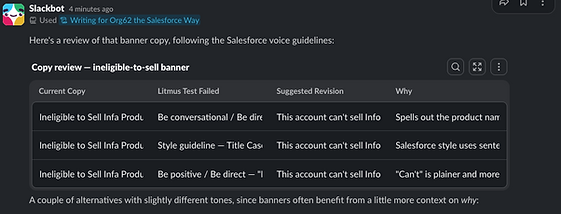
Slack Skill evaluates the content against Salesforce's voice principles and structured writing rules.
03
Provide feedback
For copy that's already been written, SlackSkill produces a structured critique.

04
Provide recommendations
When the designer needs new copy, the assistant recommends language for each relevant element.

WHY SLACK?
The tool could have lived somewhere else. But Slack is where designers and product teams already ask questions, share work, and give and receive feedback. Putting the assistant there meant it fit naturally into an existing behaviour, rather than asking people to adopt a new destination.
THE TAKEAWAY
Salesforce already had a voice, tone and writing principles. The problem wasn’t the quality of the guidance but rather the distance between the guidance and the moment a designer needed it.
By turning those principles into an on-demand Slack assistant, I shifted the guidelines from something people had to seek out into something they could use as part of their existing workflow. Instead of asking designers to become content design experts, the assistant gives them a way to get useful feedback at the point of need.
What started as a content design exercise became an opportunity to rethink how expertise could be made accessible across a complex product organisation without adding another process, repository, or destination.
SKILLS DEVELOPED
Content design
AI design
Systens thinking
Design enablement